
0
Frameworks covered: PCI DSS, HIPAA, FFIEC, SOX
Payment, healthcare, banking and financial-reporting rules all come back to the same question: can you prove that the person logging in is who they claim to be? This guide explains the multi factor authentication compliance requirements behind PCI DSS, HIPAA, FFIEC and SOX, what auditors usually ask to see, and how Spriv's out-of-band MFA is built to satisfy them.
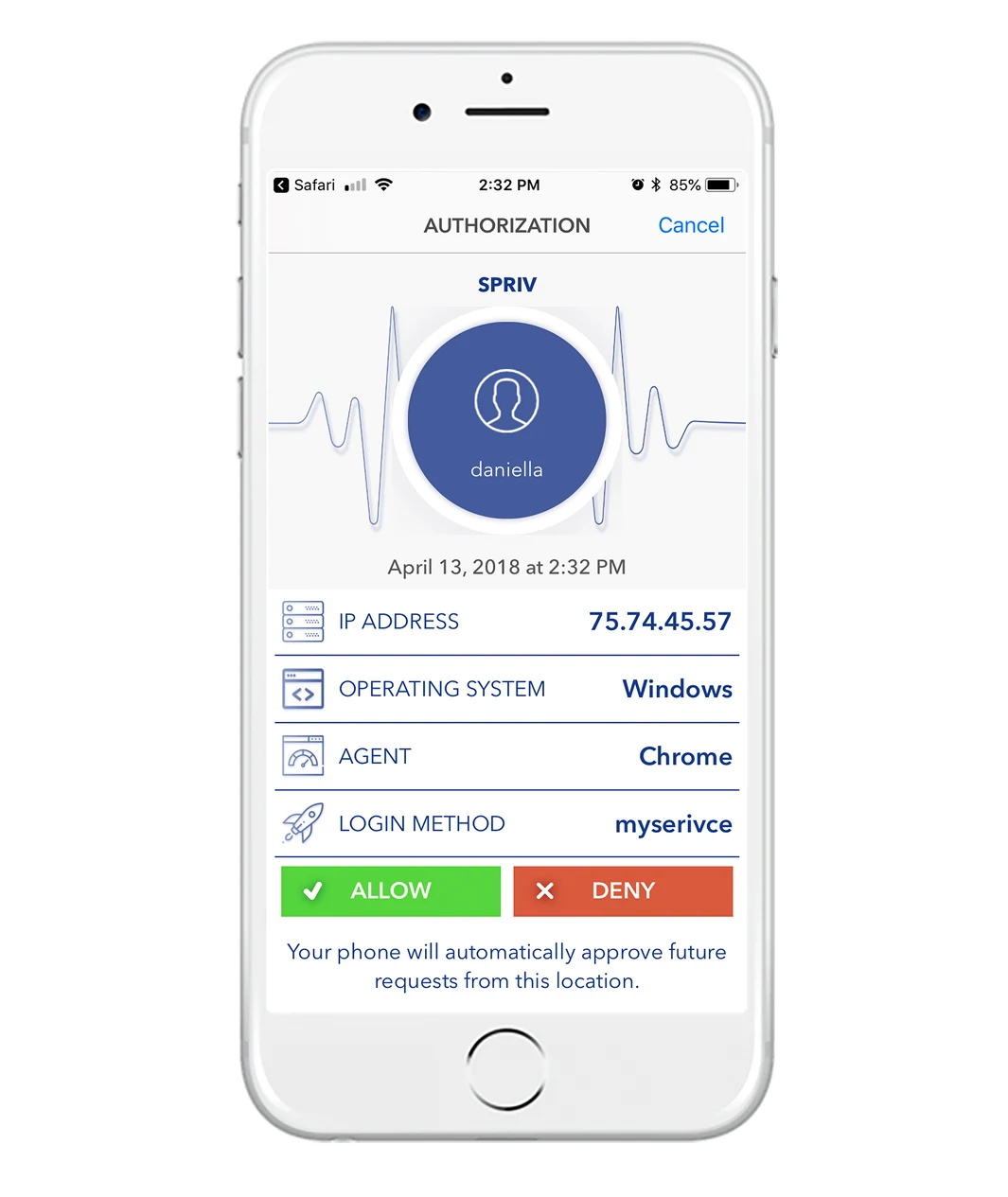
Most breaches of regulated data start with a stolen or guessed password. Regulators and industry bodies have responded by treating a password on its own as too weak for sensitive systems, and by asking organizations to show a second, independent proof of identity.
Phishing, key logging and reuse from old breaches put working credentials in attackers' hands. A second factor on another channel stops a leaked password from being enough.
Remote logins and administrator accounts reach the most sensitive data with the fewest barriers, so they are where frameworks ask for MFA first.
A control only counts if you can show it is enforced, logged and maintained when people join, leave or lose a device.
The frameworks differ in how direct they are. PCI DSS names MFA outright, HIPAA and FFIEC reach it through risk analysis and guidance, and SOX expects strong access controls without prescribing a method.
PCI DSS v4.0 and v4.0.1 cover MFA in Requirement 8.4: MFA for all non-console administrative access into the cardholder data environment (CDE), for all access into the CDE, and for remote network access from outside your network that could reach or affect the CDE. Requirement 8.5 adds rules for how the MFA system itself must be configured. PCI DSS MFA requirements in detail.
The HIPAA Security Rule requires procedures to verify that anyone seeking access to electronic protected health information (ePHI) is who they claim to be (45 CFR 164.312(d)), alongside access controls and a risk analysis. The current rule does not name MFA, but risk analyses commonly lead to it, and HHS has proposed changes that would require it. HIPAA two factor authentication.
The FFIEC's 2021 guidance, Authentication and Access to Financial Institution Services and Systems, is not a regulation, but examiners use it. It recommends MFA, or controls of equivalent strength, for high-risk users and transactions, covering customers, employees, third parties and system-to-system access. FFIEC MFA for banks.
The Sarbanes-Oxley Act does not mention multi factor authentication. What it does require is effective internal control over financial reporting, which auditors test through IT general controls (ITGCs), including who can access the systems and data behind the financial statements. MFA on privileged and remote access to those systems is a common, defensible way to strengthen that control, but it is a choice you make and document, not a line in the statute.
Turning MFA on is the start. Assessors usually want to see where it applies, that it cannot be quietly skipped, and that it keeps working as people and devices change.
MFA on VPN and remote desktop entry points, on administrator logins to servers, and on privileged commands such as sudo.
Records of approvals, denials and exceptions that can be reviewed and retained under your log-retention policy.
When someone leaves, their second factor is revoked alongside their account, so a forgotten phone does not keep working.
A documented, verified way to replace a lost or stolen phone that does not become a back door around the control.
Any bypass is approved by management, limited in time, recorded and reviewed, never a standing workaround.
Factors of different types, checked so that compromising one does not hand over the other.
Spriv's adaptive MFA checks the password, the paired phone and the known workstation, verifying the second factor out-of-band on a channel separate from the login.
It helps you meet the requirements above; it does not make you compliant on its own. Your policies, scoping and evidence still decide the audit outcome.
The second factor is checked on the phone, not the session the attacker may control.
Spriv confirms the phone and computer locations align and never shares the phone's actual location.
Set any user to Active, Deny, Bypass or Locked from the control panel. Adding users
Swap a lost phone in under a minute; keep a recovery code and at least two admins on different phones. Account recovery
Banks and large institutions can host Spriv on Custom Servers in their own data center.
No product can do that alone. Spriv's MFA is built to satisfy the authentication expectations of PCI DSS, HIPAA, FFIEC and SOX, and helps you meet them. Compliance also depends on scoping, policies, logging and evidence, which your auditor or QSA assesses.
Generally yes, as long as the factors come from different categories, such as a password and a phone. Two passwords, or a password and a security question, are one factor type and usually do not count. Two factor authentication explained.
Treat it as an exception: approved by management, documented, limited in time and reviewed. The same applies when an admin postpones second-factor authentication for a user who forgot their phone, which Spriv limits to 72 hours.
Spriv is designed so that zero personally identifiable information is transferred. It confirms that the phone and the computer are in matching locations without sharing where the phone actually is.
Yes. Spriv can verify events such as wire transfers or address changes on the second channel, which matters for banking guidance in particular. Transaction authentication.
Two free users and two free servers, no credit card. Install in under five minutes and test it against your own audit checklist.