
0
Year the current FFIEC guidance was issued
The FFIEC authentication guidance tells examiners and institutions what good access control looks like at a bank or credit union: risk assessments, layered security, and multi factor authentication for high-risk users and transactions. For banking providers, Spriv delivers an essential layer of security above username-and-password, built to satisfy the FFIEC MFA requirements without adding friction to every login.
In August 2021 the FFIEC issued Authentication and Access to Financial Institution Services and Systems. It replaced the 2005 internet banking authentication guidance and its 2011 supplement, and it is broader: it looks at everyone and everything that accesses the institution's systems, not only online banking customers.
It is guidance, not a regulation. Institutions are expected to assess risk and choose controls to match, and examiners use it to evaluate those choices.
It recommends MFA, or controls of equivalent strength, for high-risk users and high-risk transactions, and treats single-factor authentication as weak for those cases.
Customers, employees, third parties and system-to-system access are all in scope, including privileged and remote access.
Authentication is one layer among several. The guidance also calls out risk assessments that are kept current and monitoring for suspicious access.
The guidance asks institutions to match the strength of authentication to the risk of the activity. These are the activities most risk assessments rate highest.
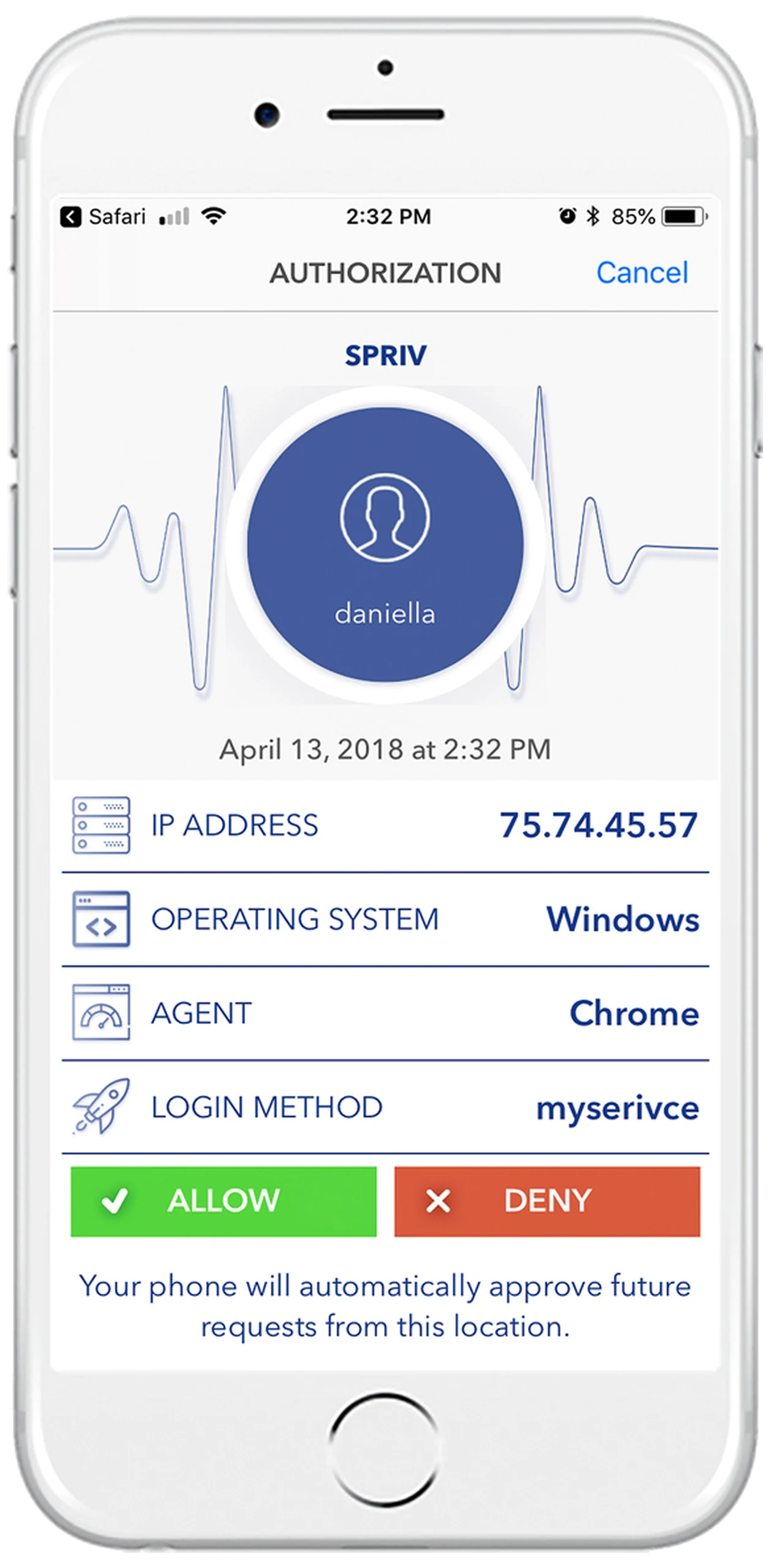
Customers reuse passwords, and credential stuffing turns old breaches into account takeovers. Spriv's API lets your platform check the customer's paired phone against the device and location of the login, so routine logins clear silently and unusual ones are challenged. Risk based MFA.
A logged-in session can still be hijacked. Authenticating the transaction itself, on the second channel, catches the fraud a login check never sees: an Allow/Deny prompt or two-way SMS for a wire above a threshold, a new payee or an address change. Transaction authentication.
Staff and vendors connecting remotely to core banking, loan origination or back-office servers need more than a password. Spriv adds MFA to Windows and RDP logins and to SSH on Linux and Unix servers.
Privileged accounts can change configurations, limits and permissions. Keep them on an explicit Allow/Deny step for production access, alongside adaptive checks for routine work.
Spriv's patented approach lines up with the layered, risk-based model the guidance describes.
Each request is weighed on geographic location, device reputation, login history, behavioral patterns, time of access and network characteristics.
The second factor is verified on the phone, a channel separate from the browser or session an attacker may control.
Spriv's patented check compares the distance and speed between the phone's location and a second transaction, flagging moves no one could make. Impossible travel detection.
Banks and large institutions can host Spriv on Custom Servers in their own data center. Everyone else uses Spriv's shared cloud servers.
Titles include "Method and system for validating electronic transactions". Patents
Spriv confirms the phone and computer locations align, without sharing the phone's actual location.
Sample code in five languages for online and mobile banking. API reference
It is supervisory guidance rather than a regulation, but examiners at the FFIEC member agencies use it when they review an institution's authentication and access controls, so in practice it sets expectations.
Yes. The NCUA is an FFIEC member, so multi factor authentication for credit unions follows the same risk-based guidance as for banks.
No. Adaptive MFA approves a matching phone-and-device pair in the background, and prompts only on abnormal information. That keeps prompts rare enough that customers read them instead of approving out of habit.
No vendor can. Spriv's MFA is built to satisfy FFIEC expectations and helps you meet them; your risk assessment, policies and controls decide how examiners view your program.
Two free users and two free servers, no credit card. Try it on your own servers, then talk to us about Custom Servers for your data center.