
0
Separate channels: the session and the phone
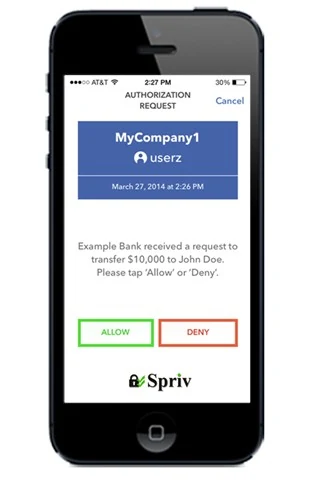
Logging in safely is only half the job. Transaction authentication verifies the actions that move money or change an account, a wire transfer, a new payee, an online order, on a second channel the attacker does not control. Spriv sends the transaction to the user's phone for an Allow or Deny, or a reply by text, and returns the answer to your application.
Multi factor authentication at sign-in proves who opened the session. It says nothing about what happens inside the session afterwards, and that is exactly where the most damaging fraud takes place.
An attacker who steals a session cookie or token after login inherits a fully authenticated session. No second factor is asked for again, so every action they take looks legitimate.
Malware inside the user's browser can quietly change a transfer's amount or destination while showing the user the original details on screen. The user logged in properly, and still lost the money.
Changing the email address, phone number or mailing address lets an attacker lock the real owner out and redirect statements, cards and password resets.
Routine logins stay silent with adaptive MFA. The Allow / Deny prompt is reserved for the events that matter, so customers read it instead of tapping through.
Send any transfer above your chosen amount to the customer's phone with the amount and destination, and release it only on Allow.
Adding a new beneficiary or changing a mailing address is a classic first step in fraud. Confirm it out-of-band before it takes effect.
A reset on a privileged or high-value account should be confirmed on the paired phone, so a reset link alone cannot hand over the account.
Define your own triggers, then choose which method each user experiences for each event. Allow / Deny push.
In card not present fraud, a criminal uses stolen card details online, where no one can see the physical card. A confirmation on the cardholder's phone is something the thief does not have.
With two-way SMS, Spriv texts the customer a question about the order and the customer replies yes or no. The reply is sent to your endpoint by HTTP POST, so your checkout can ship, hold or cancel automatically. Two-way SMS needs no app and is billed per message. SMS verification.
Did you buy a laptop from
'examplecompany' for $476?
Reply yes or no.

> yes
→ reply POSTed to your endpoint
→ order released
Spriv's origins are in exactly this problem. In 2010 the NAVTEQ Global LBS Challenge judges described it as "a solution for automatic Internet authentication, preventing fraudulent use of stolen credit cards and user/password information by tying their use to the owner's mobile phone location."
Patents including "Method and system for validating electronic transactions" and "Method and system for monitoring and validating electronic transactions".
"Method for reducing fraud in on-line transactions", US 11,308,477 and US 10,521,786. See the patents.
Two transactions too far apart for the time between them are flagged in real time, under US 9,727,867. Impossible travel detection.
Spriv's REST API has sample code in five languages. You authenticate with an API key and secret from the control panel's Service Account.
When a high-risk action starts, your application calls the API with the user and the transaction details to show, plus browser agent data such as cookies for the fingerprint comparison.
The user sees the request on the paired phone as an Allow / Deny prompt, or receives a two-way SMS and replies yes or no.
Your application receives allow or deny, or the SMS reply POSTed to your endpoint, and completes or blocks the transaction. API reference.
It means the confirmation happens on a separate channel from the session that requested the transaction, here the user's phone. An attacker controlling the browser cannot see or answer it.
Only if you choose to. Spriv recommends adaptive MFA for routine activity and Allow / Deny only for exceptions, such as transfers above a threshold, so prompts stay rare and get read.
Not for two-way SMS, which works on any phone with text messaging. Allow / Deny prompts and adaptive checks use the Spriv app on iOS or Android.
Spriv's MFA is built to satisfy FFIEC, PCI DSS, HIPAA and SOX requirements and helps you meet strong-authentication expectations for high-risk transactions. Confirm the details of your own obligations with your auditor.
Two free users and two free servers, no credit card. Add transaction verification through the API and keep routine activity silent.